

An ear that feels blocked as an aircraft descends is responding to a pressure problem, not simply to the loudness of the cabin. The air outside the eardrum and the air inside the middle ear need a way to come back toward the same pressure.
That distinction explains why the sensation often appears during a change in flight phase, why swallowing can sometimes help and why a quiet cabin does not eliminate the possibility. It also helps separate ordinary pressure equalisation from symptoms that deserve medical attention.
Locate the small air space behind the eardrum
The middle ear lies behind the eardrum. Its connection to the back of the nose and upper throat is the eustachian tube. Air movement through that route helps equalise pressure on either side of the eardrum.
MedlinePlus explains ear barotrauma as discomfort, and sometimes injury, associated with a pressure difference across the eardrum. Swallowing and yawning can open the eustachian tube. If the passage is blocked, equalisation becomes harder; congestion from a cold or allergies can contribute.
The tube is an air route, not a pipe carrying outside sound directly into the throat. On a simplified ear diagram, trace the outer ear canal to the eardrum first, then identify the separate middle-ear space and its connection toward the throat.
Aircraft height and cabin pressure are different quantities
A commercial aircraft’s cabin is pressurised. The pressure passengers experience therefore does not simply match the outside air at the aircraft’s cruising altitude.
The CDC Yellow Book’s air-travel guidance explains that cabin pressure changes during ascent and descent. Pressure generally falls during ascent and rises during descent. Barotrauma can occur when pressure inside an enclosed body space, including the middle ear, does not match the cabin environment.
A flight-tracking display showing height above sea level is consequently not a direct middle-ear pressure measurement. It describes the aircraft’s position. The cabin system, the changing outside environment and the person’s ability to equalise all belong to the larger explanation.
Follow the direction of the pressure difference
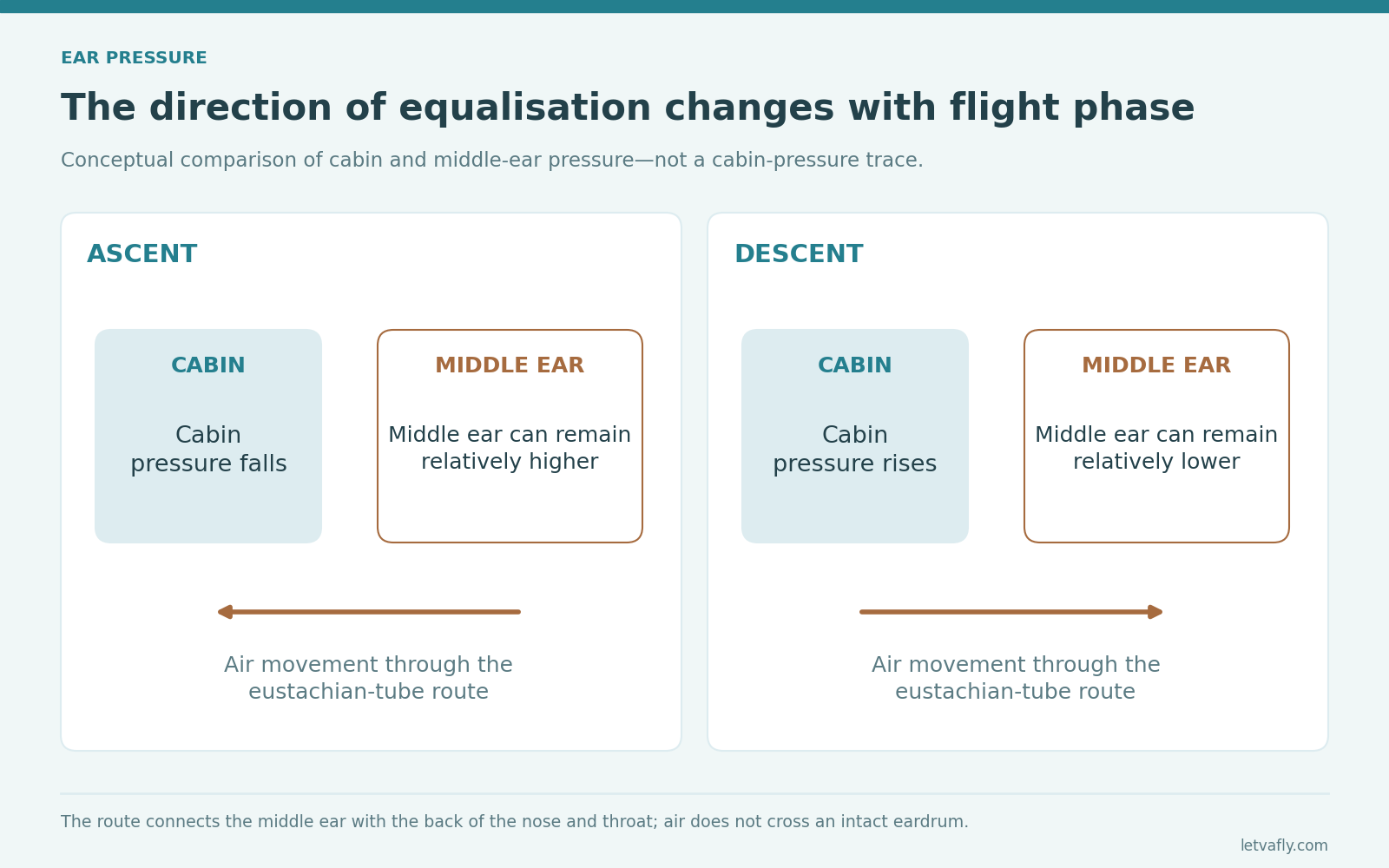
During ascent, falling cabin pressure can leave the middle-ear air at a relatively higher pressure until air can escape through the connecting passage. During descent, rising cabin pressure can leave the middle ear at a relatively lower pressure until air enters.
The direction matters because “my ears react to altitude” leaves out what is changing on each side. A clearer description is that the surrounding cabin pressure is changing and the enclosed middle-ear space is trying to equalise with it.
| Flight phase | Cabin pressure trend | Equalisation question |
|---|---|---|
| Ascent | Generally falling | Can middle-ear air move out as needed? |
| Stable cruise | More stable than during the main transitions | Has the pressure difference settled? |
| Descent | Generally rising | Can air enter the middle ear as needed? |
This is a conceptual comparison, not a pressure chart for a particular aircraft. Real cabin schedules vary, and the table cannot predict an individual’s symptoms.
What a pop does and does not tell you
The familiar pop can accompany a change as the air space equalises. It is a sensation to describe, not a measurement of how much pressure was present or proof that every ear structure is normal.
It can help to separate three observations: the feeling of pressure, the moment of a pop and whether discomfort or altered hearing remains afterward. Combining them into “my ears were bad” loses information that could matter in a later conversation with a clinician.
A fictional travel note might read: “Fullness began during descent, a pop occurred after swallowing, and the fullness then eased.” That records a sequence. It does not assign a diagnosis or claim that the same sequence will occur on the next flight.
Use ordinary movements without turning them into a contest
Swallowing and yawning are ordinary ways the connecting passage can open. The aim is not to produce the loudest pop or force a particular sensation.
People who repeatedly have difficulty, have significant congestion or have recently had ear treatment can discuss upcoming travel with a healthcare professional. That conversation can account for circumstances a general explanation cannot assess.
Keep practical preparations simple: know when the flight is beginning its descent, keep necessary personal items accessible and avoid letting an entertainment task distract you from persistent discomfort. Any changes to prescribed treatment should come from the person responsible for that care.
Sound comfort and pressure comfort need separate questions
Headphones change the listening environment. Ear pressure concerns the difference across a biological membrane and the route for air equalisation. A product description addressing one problem should not be assumed to prove an effect on the other.
When comparing travel accessories, identify the exact promised outcome. Reducing perceived engine noise, fitting comfortably and changing the rate of pressure equalisation are different claims that would need different evidence.
This separation is useful even without buying anything. If the complaint is pain during descent, turning down audio may improve listening comfort but does not explain whether the middle-ear pressure has equalised.
Know when the question has moved beyond ordinary flight comfort
Severe pain, drainage or bleeding from the ear, or discomfort that does not settle should be assessed rather than dismissed as a routine travel inconvenience. New or substantial hearing change also deserves prompt professional attention.
If symptoms occur on board and assistance is needed, tell the cabin crew what is happening. Describe the symptom and timing plainly instead of trying to identify a cause from a diagram.
For later appointments, a short record of the flight phase, the affected ear and what persisted after landing can be more useful than an elaborate theory. Include relevant recent ear procedures or illness when the clinician asks.
Read the flight through two connected systems
The aircraft cabin changes the surrounding pressure, while the eustachian tube helps the middle ear respond. Keeping those two systems distinct makes the familiar sensation easier to understand.
The practical lesson is to notice the transition, describe the experience accurately and recognise when symptoms need assessment. The biological lesson is broader: a small passage and a thin membrane can turn a change in the external environment into a very noticeable physical experience.